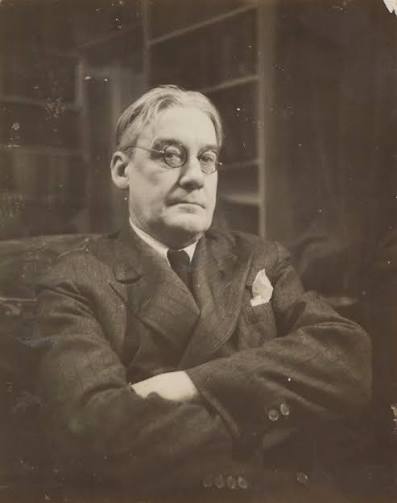
 Oliver Strachey (November 3, 1874 – May 14, 1960) was a British civil servant, distinguished cryptanalyst, and musicologist whose life traversed
significant political and cultural milestones of the late nineteenth and twentieth centuries.
Oliver Strachey (November 3, 1874 – May 14, 1960) was a British civil servant, distinguished cryptanalyst, and musicologist whose life traversed
significant political and cultural milestones of the late nineteenth and twentieth centuries.Queer Places:
Eton College, Windsor SL4 6DW, United Kingdom
University of Oxford, Oxford, Oxfordshire OX1 3PA
Bletchley Park, The Mansion, Bletchley Park, Sherwood Dr, Bletchley, Milton Keynes MK3 6DS, United Kingdom
Oliver Strachey (November 3, 1874 – May 14, 1960) was a British civil servant, distinguished cryptanalyst, and musicologist whose life traversed
significant political and cultural milestones of the late nineteenth and twentieth centuries.
Born in London into the prominent and intellectually formidable Strachey family, he was the son of Lieutenant General Sir Richard Strachey and Jane Maria Grant, a leading suffragist. Raised in a highly cultured and progressive environment alongside nine siblings, Oliver received a traditional British education at Eton College and Balliol College, Oxford, before briefly pursuing a career as a pianist and studying music in Vienna.
Finding a more stable path in public service, Strachey joined the Foreign and Commonwealth Office and spent time working in India. During World War I, his sharp analytical mind led him to the Intelligence Corps, where he began his celebrated career in military codebreaking. Working in MI1b, he specialized in breaking enemy diplomatic codes. During the interwar period, he contributed to official history projects and advocated for social causes, supporting his second wife, Rachel "Ray" Costelloe, a leading feminist activist, politician, and writer who played a central role in the National Union of Societies for Equal Citizenship.
At the outbreak of World War II, Strachey was called back into service at Bletchley Park, the central site for British codebreaking operations. Serving as a senior cryptanalyst in the Government Code and Cypher School (GC&CS), he led the "ISOS" (Intelligence Service Oliver Strachey) section. His team successfully decyiphered high-level German Abwehr intelligence communications, providing vital cryptographic material that fueled the Double Cross System, allowed British intelligence to monitor enemy spy networks, and played a crucial role in safeguarding Allied deception efforts before D-Day. He was awarded a Commander of the Order of the British Empire (CBE) for his war service.
Oliver Strachey's primary personal connection to LGBTQ history lies in his position within the deeply interconnected web of the Bloomsbury Group, a famous circle of English writers, intellectuals, and artists whose members challenged early 20th-century social and sexual orthodoxies. While Oliver lived a heteronormative life—marrying Ruby Mayer, with whom he had a daughter, author Julia Strachey, and later marrying Ray Costelloe—he operated at the center of an intensely queer familial and social environment.
His younger brother, Lytton Strachey, was one of the most prominent openly gay literary figures of his generation and a central figure in the Bloomsbury Group, maintaining well-documented relationships with men such as painter Duncan Grant and economist John Maynard Keynes. His younger sister, Pernel Strachey, served as Principal of Newnham College, Cambridge, and lived in long-term female partnerships, while his eldest sister, Philippa Strachey, was a lifelong suffragist who spent her life with her partner Joan Coster. Furthermore, his sister Dorothy Bussy authored Olivia, a groundbreaking 1949 early lesbian novel that explored intense female relationships in a boarding school environment.
Oliver's own daughter, Julia Strachey, became a writer fully integrated into the queer literary circles of Bloomsbury, associated closely with Virginia Woolf and the Memoir Club. His second wife, Ray, was the niece of Mary Whitall Smith and a close relative of prominent queer cultural figures, including writer Alys Pearsall Smith and Logan Pearsall-Smith. Throughout his life, Oliver Strachey maintained warm, supportive, and active relationships with his siblings, serving as a sympathetic figure within a pioneering family network that actively dismantled Victorian social taboos and championed sexual liberation, artistic freedom, and gender equality. He died in London on 14 May 1960 at the age of 85.

Oliver Strachey by Duncan Grant (1885–1978), Charleston
References:
Support this project
This website is a passion project researched, developed, and funded entirely by me. If you find the content valuable and would like to help support the ongoing research and hosting costs, any contribution is deeply appreciated.
Thank you for keeping this independent resource alive!
My books on Amazon: Elisa Rolle's books